Table of Contents
Property investment in Dubai has long attracted global attention — but beyond luxury apartments and beachfront villas lies a far quieter, highly lucrative sector: warehouses and industrial real estate. As the emirate cements its role as the logistics hub of the Middle East, demand for quality industrial space is accelerating at a pace that savvy investors simply cannot ignore.
Why Dubai? The Strategic Advantage
Dubai sits at the crossroads of Europe, Asia, and Africa — a geographic fact that translates directly into commercial value. Jebel Ali Port, the largest in the Middle East, handles over 14 million TEUs annually, while Al Maktoum International Airport is set to become the world’s largest cargo hub. For property investment strategies focused on long-term capital appreciation, this infrastructure pipeline is a powerful tailwind.
The emirate’s zero corporate tax on qualifying activities, full profit repatriation rights for foreign investors in free zones, and streamlined business licensing make it uniquely compelling. Industrial and logistics real estate benefits disproportionately from these advantages because occupiers — manufacturers, e-commerce operators, and freight forwarders — need stable, cost-efficient bases for their operations.
Key Locations for Industrial Property Investment
Not all industrial zones are created equal. The following areas define the landscape for property investment in Dubai’s industrial sector:
Dubai Industrial City (DIC) is one of the world’s largest purpose-built industrial zones, spanning over 55 km². It hosts manufacturers in food, metals, chemicals, and machinery — making it ideal for long-lease warehouse assets. Jebel Ali Free Zone (JAFZA) remains the gold standard for import-export-linked logistics, where occupancy rates consistently exceed 95%. Dubai South is the emerging frontier, designed around the Expo 2020 legacy and the expanding DWC cargo airport, offering modern facilities at comparatively accessible entry prices. Al Quoz provides mid-market industrial units close to central Dubai, attracting trade, retail logistics, and light manufacturing tenants.
💡 Investor insight: Property investment in Dubai South has delivered capital appreciation of over 18% between 2022 and 2024, driven by airport expansion contracts and a surge in cold-chain and e-commerce logistics demand.
ROI and Rental Yields
Industrial and warehouse property investment consistently outperforms residential in gross yield terms. Typical net yields range from 8% to 12% per annum — well above the 5–7% seen in prime residential areas. Lease terms are commonly three to five years with embedded annual escalation clauses of 5%, providing investors with predictable, inflation-linked income streams.
Vacancy rates in Grade A logistics facilities are at historic lows, driven by the structural growth in e-commerce, pharmaceutical cold storage, and regional distribution. Property investment in this segment carries lower tenant turnover risk because relocating a warehouse operation is far costlier than moving an apartment.
Legal Framework and Ownership Rights
Ownership structures in Dubai’s industrial sector depend on location. Inside designated free zones, foreign investors can hold 100% ownership and enjoy guaranteed land-use rights for 50-year renewable terms. Outside free zones, the mainland permits foreign ownership in approved investment zones under the 2021 Commercial Companies Law amendments. RERA (Real Estate Regulatory Agency) and DLD (Dubai Land Department) registration provide legal transparency and transactional security for every property investment registered in the emirate.
Asset Types to Consider
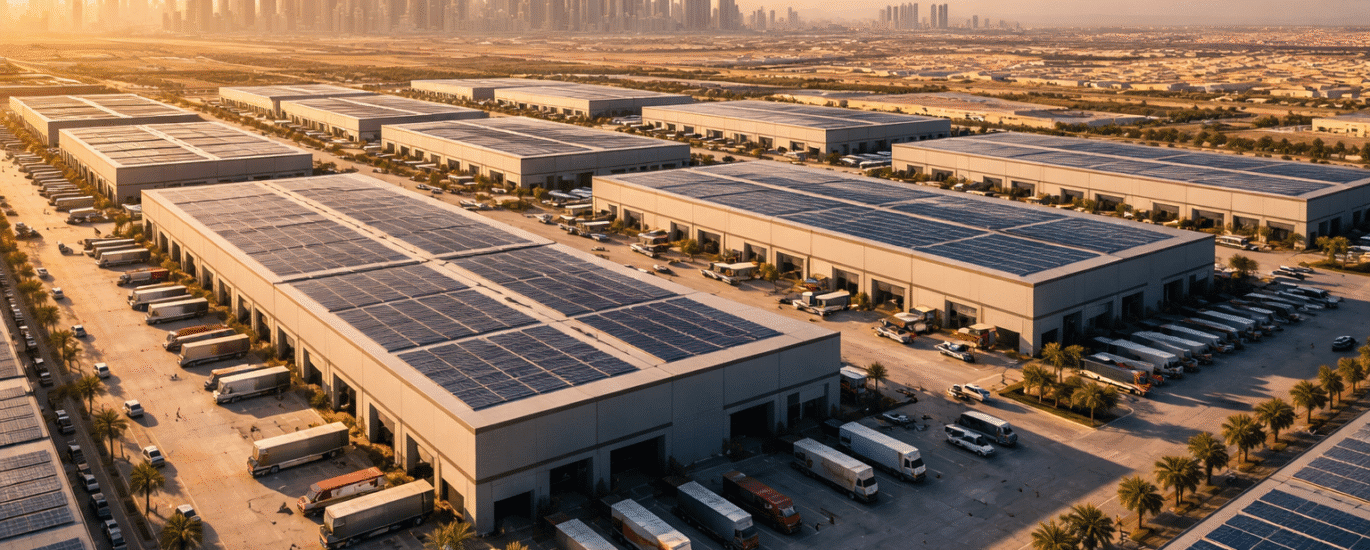
The industrial category spans several sub-classes. Bulk warehouses (10,000–50,000 sq ft) suit 3PL operators and distributors and command the highest absolute rents. Light industrial units (1,000–5,000 sq ft) appeal to SMEs and offer flexibility for smaller-ticket property investment. Cold storage facilities are structurally undersupplied relative to demand from food retail and pharmaceuticals. Showroom-warehouse hybrids in areas like Al Quoz blend commercial and logistics use, creating dual-income potential.
Risks and Due Diligence
No property investment is without risk. Key considerations include zoning classification changes, which can affect permitted use; infrastructure limitations in older industrial areas regarding power supply and road access; and tenant creditworthiness, particularly for smaller occupiers. Investors should commission an independent technical survey, verify EJARI (tenancy contract registration) compliance, and review service charge structures carefully before committing. Regulatory changes to free zone benefits, while rare, warrant monitoring given regional policy evolution.
Conclusion
Property investment in Dubai’s warehouse and industrial sector stands out as a high-yield, low-complication opportunity in today’s global real estate landscape. With tax-free returns, long-term leases, world-class logistics infrastructure, and a stable regulatory environment, Dubai offers industrial investors a rare combination of income security and capital growth potential. Whether you are entering the market for the first time or expanding an existing portfolio, the emirate’s industrial corridors deserve a serious place in your property investment strategy.
✅ Ready to Make the Smart Move?
Explore our latest smart home listings or book a free consultation with a Heptagon advisor today. Let’s help you find a home that’s not just modern—but future-ready.
Call us: +971 50 203 5824
Email: info@heptagonproperties.com
Website: https://heptagonproperties.com
Check out our contracting company: https://charminardubai.com/
Follow us on Instagram | LinkedIn | YouTube | Facebook | Tiktok
Frequently Asked Questions (FAQs)
Can foreign nationals own industrial property in Dubai outright?
Yes — within designated free zones, foreign investors enjoy 100% ownership rights on 50-year renewable leaseholds. On the mainland, full foreign ownership is available in approved investment zones under recent legislative reforms.
What yields can I expect from warehouse property investment in Dubai?
Net yields typically range from 8% to 12% per annum for Grade A and B warehouse assets, with long-term leases of three to five years often incorporating annual rent escalation clauses of around 5%.
Is there capital gains tax on property investment in Dubai?
No. Dubai levies zero capital gains tax on real estate profits. There is a one-time DLD transfer fee (typically 4%) on purchase, but ongoing tax obligations on property returns are absent for most investor structures.
Which free zones are most popular for logistics and warehouse investment?
JAFZA (Jebel Ali Free Zone) and Dubai South are the two most sought-after zones for logistics-linked warehousing. Dubai Industrial City suits manufacturing-oriented assets, while Al Quoz serves mid-market and light industrial demand.
What is the minimum investment for an industrial unit in Dubai?
Entry-level light industrial units in secondary zones can be acquired from approximately AED 2 million (±USD 545,000). Institutional-grade logistics facilities in prime free zones typically start from AED 20 million upwards.